
House Republicans Make Themselves Eligible for Trump’s $1.8 Billion Slush Fund, Reject Levin Amendment to Block Payouts to Elected Officials
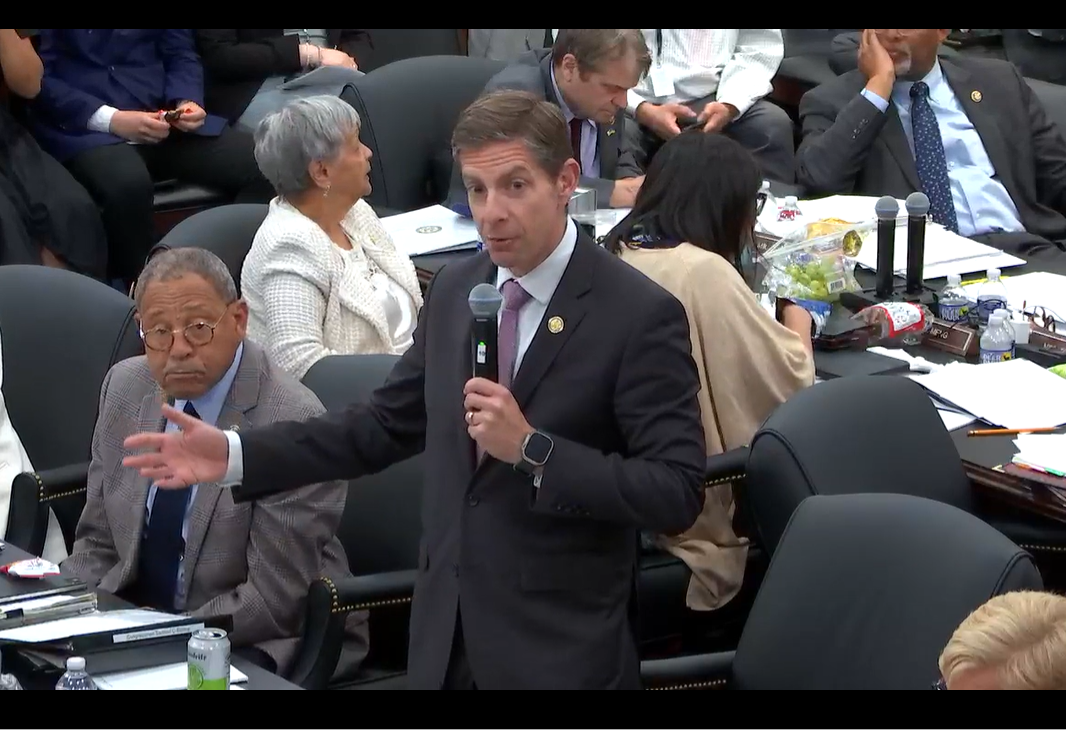
Watch Rep. Levin’s Remarks Here
Washington, D.C.—During a House Appropriations Committee markup, Rep. Mike Levin (CA-49) introduced an amendment to prevent federal elected officials from receiving any money from the U.S. Treasury Judgment Fund in response to the creation of President Trump’s $1.776 billion “Anti-Weaponization Fund.” The amendment was rejected by Republicans on the Appropriations Committee, who voted to allow themselves to receive money from the fund.
Recently, the Department of Justice (DOJ) announced the establishment of an “Anti-Weaponization Fund” as part of the settlement to end President Trump’s lawsuit against the IRS. The Judgment Fund would transfer nearly $1.8 billion to the slush fund to benefit President Trump’s allies, including Senators who believe they were victim to government weaponization and January 6th insurrectionists who attacked U.S. Capitol police officers. The U.S. Attorney General would be responsible for appointing a five-person commission to administer the payouts, and the President can fire the commissioners at any time.
Rep. Levin’s amendment would have made the President, Vice President, and Members of Congress ineligible for payouts from the Judgment Fund unless the funds were explicitly distributed through a final judgement or issued by a court. The construction of this amendment would have still allowed for elected federal officials to obtain funds from the Judgment Fund through the legal process – the process that every individual awarded a payment already has to go through.
Read Rep. Levin’s remarks as prepared for delivery below:
My amendment does one simple thing. It prohibits the arbitrary use of the Judgment Fund to pay elected officials of the United States unless there is a binding order from a court.
That is the entire amendment. And I would submit to my colleagues on both sides of the aisle that this is not a controversial proposition. It should not be a partisan one.
So let me explain why we need it, and why we need it now.
The Judgment Fund is a permanent appropriation. It was created by this Congress, in 1956, for a specific and narrow purpose. It exists so that when the federal government loses a lawsuit or settles a claim, the Treasury can pay what is owed without each one of us having to vote on every individual payment.
It is not a policy tool. It is not a campaign account. It is not a discretionary pool for any administration to draw from at will.
But that, Mr Chairman, is exactly what it is becoming.
Two days ago, the Department of Justice announced what it is calling an “Anti-Weaponization Fund.” Nearly $1.8 billion dollars. Drawn directly from the Judgment Fund. To be paid out to claimants the Attorney General selects, by a commission the Attorney General appoints, and that the President can fire at will. The processing window closes at the end of 2028 before the next Inauguration.
Mr. Chairman, that timeline should give every member of this committee pause.
Now, DOJ points to the Keepseagle settlement as precedent. With respect, the two are not comparable. Keepseagle was a court-supervised class action. The claimants were a defined group of Native American farmers and ranchers who had pursued their case through the federal courts for more than a decade. A federal judge signed off on the settlement and on who got paid.
What was announced this week is something else entirely. A permanent congressional appropriation. Repurposed by executive memo. With no enabling statute. No eligibility criteria written into law. No audit requirements. No reporting back to this body. And a commission fireable at the political whim of the very official whose allies stand to collect.
I want my colleagues on the other side of the aisle to hear me clearly on this, because I am asking you to think one administration ahead.
Imagine the next Democratic president. Imagine that president’s Attorney General standing at a podium and announcing a $1.8 billion fund. Claimants selected by the AG. Commission appointed by the AG. Fireable at the President’s discretion. Processing window conveniently closing before the next election.
Every member on your side of the aisle would be outraged. And you would be right to be.
The structure is the problem. Not the party in power. The structure.
Last November, some members will remember, the Senate slipped a provision into a continuing resolution to allow eight senators to sue the federal government for at least $500,000 apiece in connection with phone records collected during the investigation of the 2020 election. Members on both sides recoiled.
The Speaker of the House said he was “very angry,” called it self-dealing, and said it was “way out of line.” Other Republican members called it, and I quote, “stupid, quite honestly, to put that language in the bill.” Another said constituents would see it as “self-serving, self-dealing kind of stuff. And I don’t think that’s right.”
I agreed with every word of that. And this body moved, on a bipartisan basis, to repeal it.
What I am offering today is the same principle, applied prospectively, so we don’t have to do that cleanup again. The Judgment Fund should not pay elected officials. Not Democrats. Not Republicans. Not the President. Not members of Congress. Not in this administration, not in the next one, not in any future administration of either party.
This is a guardrail we should have had in place decades ago.
If you believe no elected official of either party should be cashing checks written this way out of the Treasury, with no court order, vote yes.
I want to be very explicit. My amendment includes an exception if the funds are distributed by operation of a final judgment or other binding order approved or issued by a court of the United States
I urge adoption of this amendment, and I yield back Mr. Chairman.
###